
If you’re researching gutter guards, you’ve probably heard the pitch: install them once, stop worrying about your gutters forever. It’s a compelling idea. It’s also not how it works.
We install and service gutters every day across more than 20 states. We’ve seen every type of guard on real homes, in real conditions, with real debris. Here’s an honest breakdown of what each type is designed to do, and what we actually see when we show up to service a home that has gutter guards.
The 5 Main Types of Gutter Guards
1. Screen and Mesh Guards
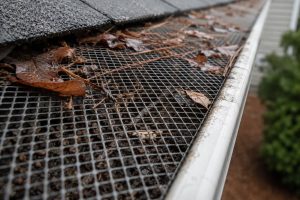 What they claim: Block leaves and large debris. Simple, affordable, easy to install yourself or have installed professionally.
What we see: They do handle large leaves reasonably well. However, larger debris often sits on top of the guard and can restrict water flow if it’s not cleared away. Smaller debris like pine needles, seed pods, shingle grit, and pollen can pass through standard mesh or get lodged in the mesh itself. Once that fine material gets into the gutter, it’s harder to remove than it would be without a guard in the way. These are the most common guards on homes we service, and they’re often not doing the job the homeowner expected.
2. Micro- Mesh Guards

What they claim: The finest filtration available. Marketed as the premium option, and the gutter guard solution that actually works where others fail. Often sold at a significant price point to match.
What we see: Micro-mesh is the best of the guard types, but “best” is relative. The mesh is fine enough to catch smaller debris, but shingle grit and pollen still get through over time. More commonly, debris builds up on the surface of the mesh itself, which blocks water from entering the gutter at all. That’s the same outcome as a clogged gutter, just harder to diagnose because it looks fine from the ground. Professional installation can run up to $25 per linear foot or more, which adds up quickly on an average home. You’re still looking at semi-annual maintenance to keep the surface clear. For homes with heavy pine tree coverage, a situation where homeowners most often seek out micro-mesh, the fine needles remain a consistent problem even with the tightest mesh available.
3. Foam and Brush Guards
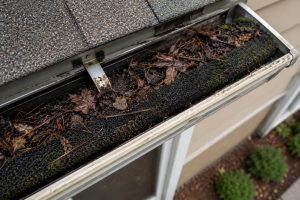
What they claim: Sit inside the gutter channel and let water through while catching debris on top. Low cost, easy to install yourself, no professional installation required.
What we see: Debris works its way into the foam and decomposes. Over a season or two, the foam itself becomes a dense, organic clog. Moss and mold growth are common. Because the foam absorbs and holds water, it can also add weight to the gutter system over time. In some cases, that extra weight may contribute to gutters losing pitch or pulling away from the house sooner than they otherwise would. What started as a $30 DIY fix becomes a gutter that needs to be cleared out completely and the foam replaced. Brush guards have the same problem. Debris collects in the bristles and doesn’t come out.
4. Surface Tension and Reverse Curve Guards

What they claim: Water follows the curve of the guard into the gutter through surface tension, while debris falls off the edge. In theory, no openings means no clogging.
What we see: In light rain, these work. In heavy rain, water overshoots the curve entirely and pours off the edge of the guard instead of into the gutter. They also perform best when the surface is clean. As dust, dirt, pollen, and other fine debris build up on the guard, the surface tension the system relies on becomes less effective. We hear this complaint consistently from homeowners in areas with significant rainfall. The guard performs fine in the conditions where you’d least need it, and fails in the conditions where you need it most.
5. Branded Systems

What they claim: Premium product, lifetime warranty, professional installation, and a guarantee that you won’t need to clean your gutters again. Often sold through in-home consultations.
What we see: Read the warranty carefully before you sign. Most require that you maintain the system professionally to keep the warranty valid, which means you’re still paying for ongoing service. The underlying technology in most branded systems is either micro-mesh or reverse curve, so the same failure modes apply.
The Problem None of Them Solve
Every guard type on this list has something in common. None of them eliminate gutter maintenance. They change the kind of maintenance, and in most cases they make it harder to spot when something is wrong.
An unguarded gutter that’s clogging will overflow visibly. A guarded gutter can fail in ways that aren’t obvious from the ground, including water sheeting off the surface of a debris-covered micro-mesh guard, or slow decomposition building up inside a foam insert. By the time you see a symptom, there’s often already water going somewhere it shouldn’t.
The math is worth doing. A professional gutter cleaning costs a fraction of what a micro-mesh installation runs. A cleaning schedule over ten years costs less than most guard systems installed once, and it actually solves the problem rather than relocating it. If you’re looking at a micro-mesh installation because you’re tired of dealing with gutters, a service plan gets you to the same place for significantly less money over time.

What Actually Works
Professional cleaning on a consistent schedule does what no guard does. It removes the debris that got in, checks for leaks and separation, confirms downspouts are draining properly, and catches small problems before they become water damage or foundation issues.
For most homes, twice a year is the baseline. Homes with heavy tree coverage need more frequent service. For homes with pine trees in particular, no guard we’ve worked with handles pine needles consistently enough to eliminate maintenance, and regular cleaning is the more consistent answer.
Still Not Sure What’s Right for Your Home?
We’ll give you a straight answer. Ned Stevens Gutter Cleaning has been servicing homes since 1965, and we include a free gutter inspection with every cleaning. If guards genuinely make sense for your home, we’ll tell you. If a service plan is the better call, we’ll tell you that too.